
What Is The Process For A Tooth Implant? What To Know About Dental Implants
If you’ve searched “what is the process for a tooth implant,” this guide will walk you through each step so you know what to expect.
You’ll learn what a dental implant is, who can get one, the typical step-by-step treatment plan, recovery, risks, costs, and how to get started. This is a practical overview meant to answer common questions and help you decide if an implant is right for you.
What is a dental implant?
A dental implant is a replacement for a missing tooth that restores function and appearance. It has three main parts: the implant post (a small titanium or zirconia screw placed in the jawbone), the abutment (a connector), and the crown or prosthesis (the visible tooth). Implants act like natural tooth roots to support chewing, stabilize neighboring teeth, and preserve jawbone over time.
Who is a good candidate?
Oral and medical health
Good candidates have healthy gums, adequate jawbone, and are free from active infections. Medical conditions like uncontrolled diabetes, certain autoimmune disorders, or heavy smoking can affect healing and candidacy. Some bone loss can be treated with grafts or sinus lifts, so many people become eligible after preparatory work.
Patient goals and expectations
Implants are recommended when you want a long‑term, fixed solution versus removable dentures or a bridge. If your goal is a natural look and strong chewing ability, implants often fit best. Bridges can work for single gaps when adjacent teeth are healthy, and dentures may suit those seeking a lower‑cost, non‑surgical choice. Discuss goals and timelines with your dentist to choose the right option.
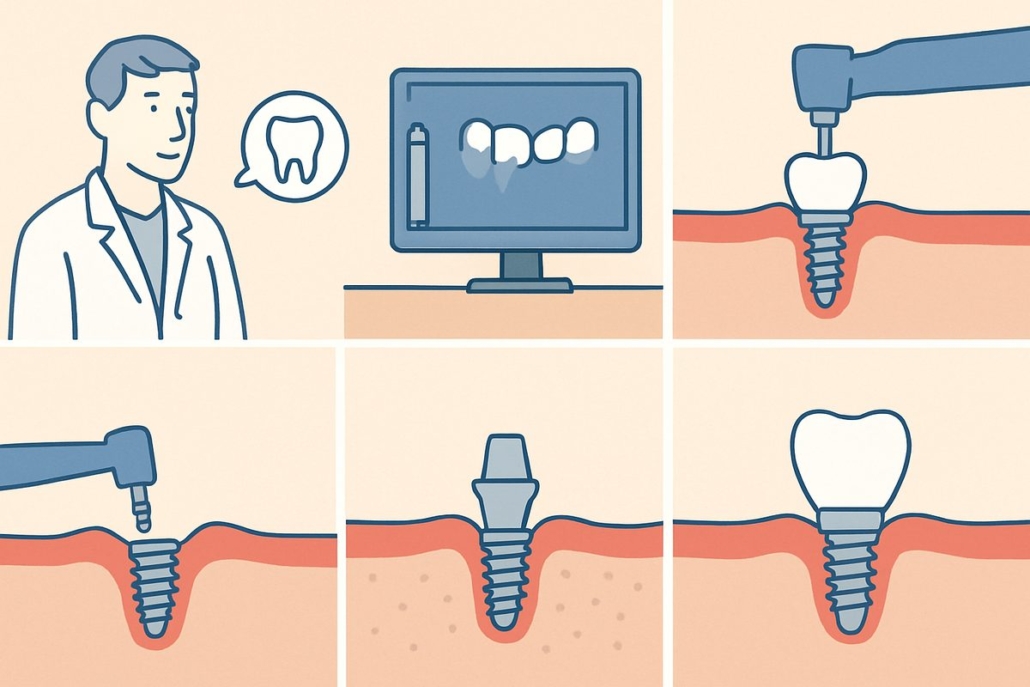
What is the process for a tooth implant — step-by-step
Consultation and digital planning
The process starts with an exam, X‑rays or a CBCT scan, and digital impressions. These tools let the dentist map bone, nerves, and sinus spaces. A clear treatment plan is made: the number of implants, whether bone grafting is needed, and whether immediate loading (same‑day teeth) is possible. Digital planning improves accuracy and outcomes.
Surgical placement of the implant
During surgery, the implant post is placed into the jawbone under local anesthesia and, if wanted, sedation. For traditional staged approaches, a healing cap is placed, and the site is left undisturbed. In immediate‑load cases, a temporary crown or prosthesis is attached the same day. The exact technique depends on bone quality and the treatment plan.
Healing and osseointegration
Osseointegration is when bone grows tightly around the implant, anchoring it. This usually takes 3–6 months for single implants, sometimes longer after bone grafts or sinus lifts. Healing timelines vary by patient health, bone density, and whether smoking or certain medications are involved. Regular follow‑ups monitor healing and bone health.
Abutment and final restoration
Once healed, the abutment connects the implant to the final crown or prosthesis. Impressions or digital scans guide lab work for a custom restoration. Materials like zirconia yield strong, natural‑looking teeth. For full‑arch cases, a fixed hybrid prosthesis may be used. Final adjustments ensure a comfortable bite and aesthetic result.
What to expect during recovery and aftercare
Expect mild‑to‑moderate soreness, swelling, and minor bleeding for the first few days. Pain control includes over‑the‑counter or prescribed medication and cold packs. Eat soft foods and avoid hard, sticky items for a few weeks. Keep the area clean with gentle brushing and salt rinses. Avoid smoking and follow all follow‑up appointments to catch issues early.
Risks, success rates, and long-term maintenance
Common complications include infection, implant failure, and peri‑implantitis (gum inflammation around implants). Most can be managed with antibiotics, cleaning, and, in some cases, revision surgery. Success rates for healthy patients are high—often above 95% for single implants over five years. Long‑term care means daily cleaning, interdental tools, and routine dental checkups to protect gum and bone health.
Costs and payment options
Price varies by the number of implants, the need for bone grafting or sinus lifts, the type of prosthesis, and lab costs. A single implant with a crown is less than a full‑arch reconstruction. Insurance sometimes covers part of restorative work, but implants are often only partially covered. Financing plans, medical credit, and in‑office payment options are common ways to manage cost. Ask for a full estimate during the consultation.
Why choose OneSolution® for dental implants
OneSolution® Dental Implant Centers focuses on implant dentistry and full‑mouth reconstructions. Led by Dr. Eli Friedman, the team offers same‑day immediate‑load options when clinically appropriate, advanced digital planning, and an in‑house lab that mills high‑strength zirconia restorations with CAD/CAM technology. Select cases include a lifetime warranty on zirconia teeth, and the centers emphasize predictable, durable, and aesthetic outcomes.
How to get started
To begin, schedule a consultation and bring any recent dental X‑rays or medical history. You’ll receive a digital exam, treatment options, and a clear cost estimate with financing choices. If you decide to proceed, the team will outline the timeline and what to expect at each visit. Call or visit the nearest OneSolution® office to set a consultation and take the first step toward a stable, natural‑looking smile.


Leave a Reply
Want to join the discussion?Feel free to contribute!